

A camping dish washing basin is judged on packed size before capacity. Campers have a fixed amount of space and a fixed amount of water, so a basin that stores flat and holds a modest volume beats a larger basin that takes up a shelf.
Key takeaways
- Packed size, weight and folded height are the three numbers that sell this product. Lead with them.
- 8L is the mainstream camping size. 16L is for families and vehicle-based trips.
- Nested sets use the same space as one basin, which is the strongest argument for selling a pair.
- A drain plug belongs on every version sold into camping, for gray water control.
Packed Size, Not Open Capacity
| Specification | What to quote | Why it matters |
|---|---|---|
| Folded height | 1.5-3 cm | Fits a drawer or under a seat |
| Folded footprint | length x width | Decides whether it fits a storage crate |
| Weight | grams | Matters for van life and hiking-adjacent use |
| Open capacity | liters | Decides how much washing one fill handles |
Most product listings lead with capacity and bury the packed size. For camping buyers the order should be reversed, because packed size is the constraint they are working against.
Camping Dish Washing Basin: Sizes by Traveler Type
A solo camper or a couple takes the 8L. A family with cookware takes the 16L, and usually two of them. Van life sits in between, and often carries an 8L plus a small bucket rather than a single large basin.
The 30L format is rarely a camping product. It belongs with BBQ preparation and group catering, where the basin is on a table rather than in a vehicle.
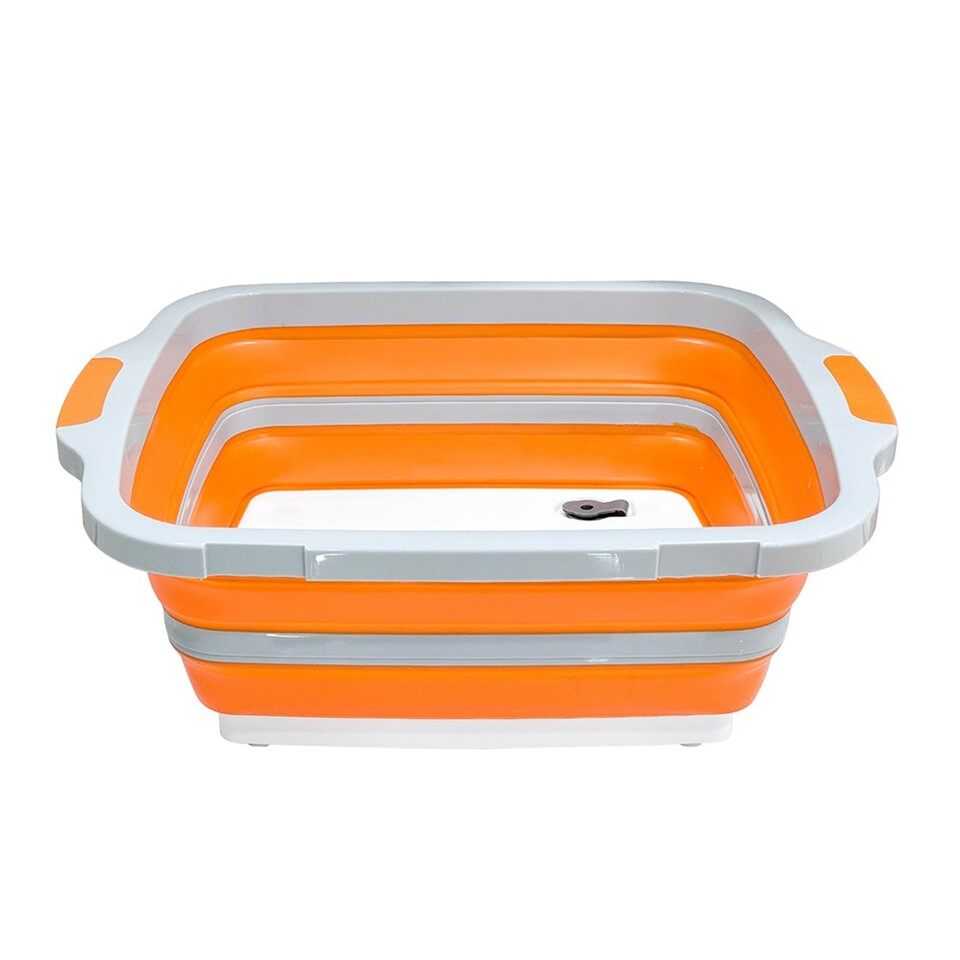
Nested Sets and Storage Math
Two basins of the same model nest, so the pair occupies roughly the footprint of one. That is the practical reason to sell a pair rather than a single large basin: same storage, better washing process.
Ask the supplier for the nested dimensions, not just the folded dimensions of one unit. It is the number the customer needs to decide whether the pair fits their van.
Materials for Portable Use
Portable use means cold nights, vehicle storage and repeated folding. Food-grade PP for the walls and TPR for the folding band is the standard combination; the band is the part that fails first in cold conditions, so it is the part to check on the sample.
Weight is decided largely by the wall thickness, and there is a floor below which the basin stops holding its shape when full. The compromise is a slightly heavier basin that carries reliably, which is what campers prefer once they have used a flimsier one.
Ordering Notes
Portable formats start at 500 to 1,000 pieces per SKU, with a three to five day sample and a 15 to 20 day bulk run. Colors, branding and nested set packaging are quoted separately.
For this channel, quote the folded height, the folded footprint and the weight on one line each. It is the shortest specification sheet in the category and the one that answers the buyer's question directly.
FAQ
What size is the most portable?
8L. It covers a couple and folds into a drawer.
Do two basins take twice the space?
No. Nested, they take roughly the space of one.
Is weight a problem?
Not in a vehicle. For hiking-adjacent use, the material and wall thickness matter.
Do portable basins need a drain plug?
For campsite use, yes, for gray water control.
A collapsible camping basin is the same product under a shorter name, and both phrases turn up in buyer searches.
Bottom line
Quote folded height, folded footprint and weight, then capacity. That is the order a camping buyer uses, and it is the order the retail packaging should follow too.
Our 8L and 16L basin formats cover the portable sizes, and the 16L basin covers family trips. For the storage side of a van kitchen, the RV basin guide covers folded profiles against locker dimensions.
A camping dish washing basin is bought on packed size first, so quote the folded profile above the capacity.